
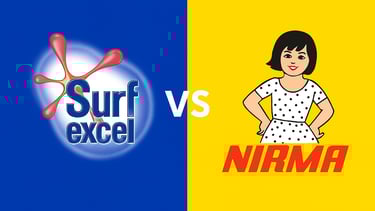
How Surf Excel Replaced Nirma — Even at 3–5x Higher Price
For almost two decades, Nirma was India’s detergent king—the household choice for value-driven families. Surf Excel (then Surf), priced significantly higher, was a secondary brand for premium households. Yet today: Surf Excel dominates the premium and mass-premium detergent market Nirma is nearly forgotten in urban India Consumers willingly pay 3–5x more for Surf Excel despite detergent being a low-involvement, functional category This shift cannot be explained by product benefits alone. It is fundamentally a psychological, behavioral, and neuromarketing transformation.
PRICE
Krishna
7/30/20233 min read

The basis for this case study is:
Behavioral Economics
Habit loop disruption
Anchoring & re-anchoring
Price-quality bias
Social identity theory
Loss aversion
Neuroscience
Sensory memory encoding- fragrance and texture
Mirror neuron activation via “dirt is good” narratives
Trust circuitry & brand schema stability
Associative learning
Psychology
Modernity aspiration
Social comparison
Family care narratives
Cleanliness-schema positioning
Phase 1: How Nirma Became the King (1980s–1990s)
Nirma's core behavioral strengths
Price anchor effect
Positioned itself as “value for money” when detergent was a luxury
Created a cognitive reference point for cheap detergent
Mnemonic advertising
“Washing Powder Nirma…” jingle
Repetition created auditory memory dominance.
Detergent as a commodity
For years, detergent had no emotional narrative.
Consumers only focused on “quantity + price”
Psychology insight
Nirma won because it fitted into economic hardship era India, when affordability was the top decision-maker.
But categories do evolve with societies.
Phase 2: The World Changed, But Nirma Didn’t
During the 2000s-2010s:
Incomes for the middle class increased.
Aspirations towards the urban setting rose.
Households spent more on quality-of-life products
"Premiumization" became widespread.
Homecare categories shifted from being price-driven to performance-driven.
But Nirma remained frozen in time:
Same jingleAd
Same low-price messaging
Minimal product innovation
Poor emotional integration
Behavioral fallout
Consumers began to view Nirma as:
obsolete
low-quality
“cheap” in a negative sense
non-progressive
This created a status loss effect, reducing its aspirational value.
Phase 3: Surf Excel rewrote the rules of detergent marketing.
The transformation strategy of Surf Excel is considered one of the most sophisticated neuromarketing successes in Indian FMCG history.
Key Shift 1: Repositioning Cleanliness Through Emotional Neuroscience
Instead of selling "whiteness," Surf Excel sold:
“Daag Achhe Hain” (Dirt is Good)
This was revolutionary.
Psychology behind the message
Placed dirt as a representation of learning, growth in childhood and exploration.
Removed guilt from stains
Made Surf Excel not just a product but a philosophy of parenting.
Neuroscience activation
Activated mirror neurons; parents were emotionally resonating with kids in the messy, playful situations
Triggered Emotional Salience: Emotional Ads remain longer in memory.
Created dopamine reward association: Surf Excel became a part of positive emotional stories.
This repositioning changed the mental category of detergent from cleaning → caring.
Key Shift 2: Price-Quality Bias & Premium Anchoring
Surf Excel priced itself high intentionally.
Behavioral economics teaches:
High price = high quality, especially in low-involvement categories.
Consumers started associating Surf Excel with:
Better fabrics
Better fragrance
Better wash experience
Better care
Even though many differences were perceived rather than chemical.
Surf Excel manufactured a high-end anchor to push consumers to justify spending more for:
“It’s better for clothes”
“It’s better for my children”
“It saves effort and time”.
Key Shift 3: Sensory Neuromarketing
Surf Excel upgraded:
Fragrance
Texture of the powder
Color of the liquid detergent
Smoothness of the granules
Neuroscience Insight:
Sensory consistency strengthens:
Reward pathways
Memory encoding
Brand familiarity
Trust formation
At every sensory touchpoint, Surf Excel felt premium.
Nirma was harsh, coarse, and old-fashioned.
Key Shift 4: Category Migration (Powder → Liquid)
Surf Excel began the charge toward:
liquid detergents
front-loading washing machine products
machine-compatible variants
This was aligned with modernizing households in India.
Nirma largely missed this transition.
Behavioral Insight
Consumers associate modern formats with modern brands.
This increases willingness to pay.
Key Shift 5: Surf Excel Built Social Identity
Surf Excel created an identity for the “modern, caring Indian parent.”
Owning Surf Excel meant:
equality
progress
modern living
good parenting
higher status
Nirma did not provide any identity.
It offered only savings.
Consumers buy identity, not detergent.
6. Why Consumers Shifted from Nirma to Surf Excel Despite Higher Prices
1. Emotional superiority beats functional price logic
The emotional messaging of Surf Excel made detergent a symbolic tool of care and parenting.
2. Sensory experience generates perceived performance
Smell, texture, lather quality influenced perceived cleanliness more than actual chemical performance. 3. Nirma became a "low-status" brand Middle-class Indian families avoid products that denote downward mobility. 4. Surf Excel became aspirational and trustworthy Trust + identity = price becomes irrelevant. 5. Habits changed forever Once consumers upgraded, returning to Nirma created loss aversion.
Conclusion:
Surf Excel did not beat Nirma on price or product alone.
It won because:
It rewired the emotional meaning of stains
It used neuromarketing to connect detergent with parenting
It elevated detergent into a premium, identity-based purchase
It modernized the category
It aligned with the psychological evolution of Indian middle-class families
Nirma became a victim of its own success:
It remained anchored in the past while Surf Excel captured the future.
People don’t pay more because Surf Excel cleans better.
They pay more because Surf Excel makes them feel better.
Contact
Reach out for insights or collaborations.
info@neuroresearch.in